|
On Saturday morning, Lisa sent me Bonnie Zampino's article called My Son Has The Kind Of Autism No One Talks About, in which Zampino addresses a neighbourhood in California that filed a lawsuit against a local family's Autistic son for being violent towards their children. While the neighbourhood claimed that, "This is not about autism. This is about public safety", Zampino calls it out for what it is - discrimination against an Autistic person and their family, and a reflection of the widespread misunderstanding of the autism reality.
Zampino writes that one of the major factors behind this incident is that the boy in California doesn't have "the kind of autism we talk about when we talk about autism". She's talking about the Autistic success stories that are so widespread in the media lately - the Jacob Barnetts of the world, the Autistic prodigies that redefine our idea of what human beings are capable of - and the off-beat, but acceptable Autistic kids, teens, and adults featured in feel-good news stories.
She writes:
For every boy with autism who manages his high school basketball team, there are 20 boys with autism who smear feces. And for every girl with autism who gets to be on the homecoming court, there are 30 girls with autism who pull out their hair and bite their arms until they bleed. And for every boy with autism who gets to go the prom, there are 50 boys with autism who hit and kick and bite and hurt other people.
Zampino talks about her son's aggressive behaviour as a young child, and how for many years, she would flinch whenever he came near her, because she couldn't predict whether he would be loving or lash out. She argues that we, as a society, aren't aware of autism - not truly - because we only talk about the high points. We don't talk about the sad, messy, violent parts of autism, and so a community in California can say: "This isn't autism."
But we used to talk about it. Less than ten years ago, the media narrative surrounding autism often displayed it at its worst - highlighting the devastating effects autism can have on a person's family, outlook, behaviours, etc. Chief culprit in this narrative of negativity was Autism Speaks - putting out videos like I Am Autism (transcript), in which the narrator, "autism", tells a parent: "If you're happily married, I will make sure that your marriage fails. Your money will fall into my hands, and I will bankrupt you for my own self-gain. I don't sleep, so I make sure you don't either."
Zampino's article reflects a sentiment that tells us we have gone too far in the other direction - spotlighting only the most positive of autism stories - that we have ended up alienating the majority of Autistic people and their families from the conversation.
I believe we are starting to find a balance. We have seen a massive shift in media awareness of autism over the past ten years, reflected in shows like Parenthood, Criminal Minds, and Grey's Anatomy, prominently featuring Autistic characters, and delivering a sensitive portrayal of what the lives of these characters and their families are often like, for better or for worse. Movies like the biographical Temple Grandin, or fictional accounts like Extremely Loud and Incredibly Close or Salmon Fishing in the Yemen, strive to depict the unique perspective of Autistic individuals, celebrating their successes while acknowledging their challenges. In print, we have potentially seen the most complex, and engaging portrayals of Autistic individuals in works like House Rules and The Curious Incident of The Dog In The Night-Time (now a Tony-award winning play!)
I think that we, as people who care deeply about Autistic children of all ability levels and personalities, have a responsibility to think critically about the media coverage of autism, and give thought to the kinds of depictions that would provide a fair and honest picture of the roller coaster that autism can be - both the incredible highs and the devastating lows.
|
Tuesday, 29 September 2015
The Autism We Talk About

Friday, 4 September 2015
A Job For Life
This week, we're looking at a great blog post from catonatrampoline, an Autism Mommy Blogger, who writes about Autism and parenthood. In her post, A Job For Life, she imagines an introduction letter from the Human Resources Manager at 'AutismLand' to the newly-minted Autism Parent, complete with required qualifications, on-the-job training, and employee benefits and incentives.
catonatrampoline writes:
"Congratulations on your successful appointment to the position of Autism Parent.
We understand that you may be confused by this appointment, as you never actually applied for the post in the first place. You may also be concerned that there are no contact details in this letter, so you cannot write, call, or email us to turn the position down. Your concerns are to be expected, and will become less over time."
For "Qualifications", she states: "the only essential qualification required is to be the parent of an autistic child", and in terms of "Training You Will Receive Before Taking Up The Post", she wryly notes: "None." (ibid.)
catonatrampoline captures the common anxiety and desperation of a new parent coming to terms with their child's diagnosis, and starting down the path of educating themselves about Autism, and how they can best support and guide their child through a world that will, at times, overwhelm them, exclude them, judge them, or deny them the same opportunities as their neurotypical peers. The battle for these parents has just begun to ensure that their child is provided with compassionate and knowledgeable caregivers, access to effective education, and inclusion in the social landscape of their environment.
I think this post is a great reminder for all of us that while the start of a new school year can be stressful for any parent, the job of an Autism parent is an even more nerve-wracking affair. Our parents are starting on a 10-month adventure of attending countless IEP meetings, dealing with teacher communication, helping with homework, pushing behavioural strategies and support, fighting tooth-and-nail to make sure that their child doesn't fall behind, and much, much more.
We need to be a haven for these parents - always, but especially during the tough first few months of school. We need to be the welcoming arms that greet them with the same compassion we extend to their children. We need to be the people that have their back, even when the day has been long, and we're tired, and they're tired, and their child is tired... It's our job to be the positive energy in the room, to be empathetic to their concerns, and to give them an account of the day that doesn't drive their cortisol levels through the roof!
Throughout September, let's all remember to check ourselves at the door (literally!) when we are greeting parents before or after a session, and to recognize that their batteries are often more depleted than ours, and that by being their cheerleader and coach, we can make the biggest impact in the lives of our families.
catonatrampoline writes:
"Congratulations on your successful appointment to the position of Autism Parent.
We understand that you may be confused by this appointment, as you never actually applied for the post in the first place. You may also be concerned that there are no contact details in this letter, so you cannot write, call, or email us to turn the position down. Your concerns are to be expected, and will become less over time."
(catonatrampoline, A Job For Life)
For "Qualifications", she states: "the only essential qualification required is to be the parent of an autistic child", and in terms of "Training You Will Receive Before Taking Up The Post", she wryly notes: "None." (ibid.)
catonatrampoline captures the common anxiety and desperation of a new parent coming to terms with their child's diagnosis, and starting down the path of educating themselves about Autism, and how they can best support and guide their child through a world that will, at times, overwhelm them, exclude them, judge them, or deny them the same opportunities as their neurotypical peers. The battle for these parents has just begun to ensure that their child is provided with compassionate and knowledgeable caregivers, access to effective education, and inclusion in the social landscape of their environment.
I think this post is a great reminder for all of us that while the start of a new school year can be stressful for any parent, the job of an Autism parent is an even more nerve-wracking affair. Our parents are starting on a 10-month adventure of attending countless IEP meetings, dealing with teacher communication, helping with homework, pushing behavioural strategies and support, fighting tooth-and-nail to make sure that their child doesn't fall behind, and much, much more.
We need to be a haven for these parents - always, but especially during the tough first few months of school. We need to be the welcoming arms that greet them with the same compassion we extend to their children. We need to be the people that have their back, even when the day has been long, and we're tired, and they're tired, and their child is tired... It's our job to be the positive energy in the room, to be empathetic to their concerns, and to give them an account of the day that doesn't drive their cortisol levels through the roof!
Throughout September, let's all remember to check ourselves at the door (literally!) when we are greeting parents before or after a session, and to recognize that their batteries are often more depleted than ours, and that by being their cheerleader and coach, we can make the biggest impact in the lives of our families.
Monday, 17 August 2015
Encouraging Imaginative and Creative Play
This week, our article comes from Vancouver-based Play Therapist and Clinical Counselor, Kathy Eugster.
Kathy covers a broad swath of the background behind the development of imaginative and creative play, and provides an immense library of practical and specific ideas for stretching our children's play repertoires!
Kathy's ideas are geared towards children of all abilities, but many of her comments fit our children and our practice perfectly, and bring up some relevant issues and questions.
Children need a clean and organized space for play. This means you will need to organize and set up the play area yourself. It also means you will need to facilitate clean up at the end of playtime, and that likely you will be doing quite a bit of the clean up and organizing yourself, especially for younger children. Even though it is important to encourage your child to help in cleaning up the toys, it is your job to provide your child with a clean and organized space and with the necessary toys and materials for creative and imaginative play.
Setting up our play spaces and keeping them clean is something that comes up often between our staff, and it rings true in Kathy's writing. As our centre expands, our play spaces change, and with that change comes a new appreciation for how absolutely sacred those spaces are.
It is crucial for us to keep those spaces neat, so others can come and play - and to respect each other in those spaces by allowing all kids the opportunity to either join in what's already going on, or carve out their own area for imaginative and creative play. It is so easy to become possessive or defensive or those spaces, especially when our child is super engaged or excited about a new play idea. Those moments can be transcendant, but we still need to be mindful that everyone has an opportunity for the same experience.
If your child is playing with other children, your job is to supervise the play. Don't expect to leave them on their own and that things will go smoothly without your intervention. You will need to monitor the play and intervene before things get out of control and tempers are lost between the playmates. Keep in mind, however, you don't want to be too restrictive and intrusive if your child is playing with someone else. Social play with other children is one of your child's main ways of learning to interact with others in the world. Allow children to work things out themselves up to a certain point before you intervene.
One aspect of facilitating play (and communication, for that matter) that can often be difficult is knowing how much to prompt, when to prompt, and when to back away and let things play out. This is something I've been trying to look at lately, and I would really appreciate hearing everyone's thoughts in the comments section.
When a child is struggling to get their message across, should we be prompting the other child to respond, or teaching the first child how to get their message across more effectively? When we prompt the response, are we turning a peer-peer conversation into a child-teacher conversation?
When we police a game to make sure everyone is following the rules, are we implying that is solely the teacher's responsibility to make sure everyone is playing fair? From preschool to high school, children will correct each other's behaviour naturally, as a back-and-forth routine to help each other understand the social conventions and mores. Are we taking away our children's abilities to give directions to their peers?
These are pertinent questions I think we need to be continually asking ourselves, to ensure that we are helping our children learn skills, rather than simply directing them through their daily activities.
Take a look at Kathy's fantastic article, and please share your thoughts in the comments section below!
References:
Eugster, K. (n.d.) Encouraging Children to Play Imaginatively and Creatively. Retrieved August 10, 2015, from http://www.kathyeugster.com/articles/article007.htm
Kathy covers a broad swath of the background behind the development of imaginative and creative play, and provides an immense library of practical and specific ideas for stretching our children's play repertoires!
Kathy's ideas are geared towards children of all abilities, but many of her comments fit our children and our practice perfectly, and bring up some relevant issues and questions.
Children need a clean and organized space for play. This means you will need to organize and set up the play area yourself. It also means you will need to facilitate clean up at the end of playtime, and that likely you will be doing quite a bit of the clean up and organizing yourself, especially for younger children. Even though it is important to encourage your child to help in cleaning up the toys, it is your job to provide your child with a clean and organized space and with the necessary toys and materials for creative and imaginative play.
Setting up our play spaces and keeping them clean is something that comes up often between our staff, and it rings true in Kathy's writing. As our centre expands, our play spaces change, and with that change comes a new appreciation for how absolutely sacred those spaces are.
It is crucial for us to keep those spaces neat, so others can come and play - and to respect each other in those spaces by allowing all kids the opportunity to either join in what's already going on, or carve out their own area for imaginative and creative play. It is so easy to become possessive or defensive or those spaces, especially when our child is super engaged or excited about a new play idea. Those moments can be transcendant, but we still need to be mindful that everyone has an opportunity for the same experience.
If your child is playing with other children, your job is to supervise the play. Don't expect to leave them on their own and that things will go smoothly without your intervention. You will need to monitor the play and intervene before things get out of control and tempers are lost between the playmates. Keep in mind, however, you don't want to be too restrictive and intrusive if your child is playing with someone else. Social play with other children is one of your child's main ways of learning to interact with others in the world. Allow children to work things out themselves up to a certain point before you intervene.
One aspect of facilitating play (and communication, for that matter) that can often be difficult is knowing how much to prompt, when to prompt, and when to back away and let things play out. This is something I've been trying to look at lately, and I would really appreciate hearing everyone's thoughts in the comments section.
When a child is struggling to get their message across, should we be prompting the other child to respond, or teaching the first child how to get their message across more effectively? When we prompt the response, are we turning a peer-peer conversation into a child-teacher conversation?
When we police a game to make sure everyone is following the rules, are we implying that is solely the teacher's responsibility to make sure everyone is playing fair? From preschool to high school, children will correct each other's behaviour naturally, as a back-and-forth routine to help each other understand the social conventions and mores. Are we taking away our children's abilities to give directions to their peers?
These are pertinent questions I think we need to be continually asking ourselves, to ensure that we are helping our children learn skills, rather than simply directing them through their daily activities.
Take a look at Kathy's fantastic article, and please share your thoughts in the comments section below!
References:
Eugster, K. (n.d.) Encouraging Children to Play Imaginatively and Creatively. Retrieved August 10, 2015, from http://www.kathyeugster.com/articles/article007.htm
Sunday, 9 August 2015
What's Your Favourite Toy?
I was up at my cottage over the long weekend, and I found an old computer (circa 1977) in our old bedroom. Even if we had been able to power it up, I don't think there's a single thing it could have done without overloading and sputtering to a slow and embarrassing death. I thought, "Wow - I can't believe that piece of junk is still here!" And then a moment later, I remembered why we'd kept it all these years.

When my cousins and I were kids, we would sit around that computer for hours - without even turning it on - playing GhostWriter, pretending we were in mission control for a NASA space launch, imagining we were breaking into top secret networks. That old useless computer was a launching board for our epic imaginative adventures! It didn't matter that it was objectively a piece of techno-junk; for us, that computer was a window to countless other realities.
As adults, we often tend to look at objects as they are. In our business, this can be especially true.
"This is a spoon. What do you do with a spoon? You eat with it! A spoon is a kind of... cutlery!"
But a spoon can be so much more! A spoon could be a ninja turtle's snowboard, racing down the hill away from approaching bad guys! A spoon could be a fun musical instrument! A spoon could be a new friend to play with! A spoon could be a magic wand, or a conductor's baton!"This is a spoon. What do you do with a spoon? You eat with it! A spoon is a kind of... cutlery!"
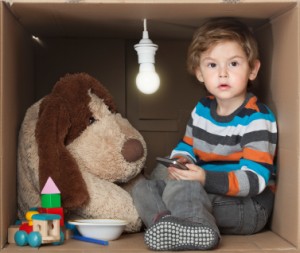
Teaching our kids that an object can represent many things is the basis for symbolic play. At around 18 months, TD kids will start to pretend using things in their environment for lots of different purposes. One of the milestones on the VB-MAPP is "plays with everyday objects in creative ways"! Yet, when this target shows up on our data sheets - we seem to find it immensely hard to get our kids to do it!
We need to lay the groundwork for this step by stretching our kids concepts of what is acceptable, appropriate and fun in their day-to-day play! At first, our kids might think we're just being silly, but for those who are ready for it - a little persistence and energy can go a long way in getting them excited about it and thinking creatively.
What were your favourite toys as a child? Did they have a million moving parts, or cool sounds, or incredible features? Or were they a canvas for you to paint your imaginative landscapes? When we look at the objects around us with our childhood eyes, we invite our kids to join us in a world of endless possibility. Let's try to bring this imaginative awareness to our play this week, and see if we can bring our kids imaginations online!
Please leave a comment telling us what your favourite toys were as a child, and/or what toys you love to bring into your play with your students! As per our guidelines, please refrain from using any child's name (or even initials) in your post, and endeavour to use general language that could be applicable in a broad sense, rather than making specific references. Thanks!
Subscribe to:
Posts (Atom)